

Pedro Lazzarotto
2 September 2025
Huawei OceanStor with Canonical Kubernetes – integration verification report

A note from the editor: This post was written by Zhanglei Mao.
This blog explores the successful integration of Huawei OceanStor hybrid flash storage systems with Canonical Kubernetes, demonstrating how enterprises can unlock resilient, enterprise-grade storage in cloud-native environments. The integration benefits companies across different industries seeking reliable, scalable containerized infrastructure. This collaboration enables dynamic volume provisioning, snapshots, and seamless storage management, helping businesses accelerate their digital transformation with a flexible and future-proof Kubernetes platform.
Project overview
Project background
Huawei OceanStor hybrid flash storage systems are designed to carry mission-critical and general-purpose services of enterprises, financial institutions, and data centers (DCs). It meets the requirements of all NAS scenarios and applies to small- and medium-sized enterprises and hybrid applications that do not have high performance requirements, such as database applications on container platforms. It helps finance, manufacturing, telecommunication carriers, and other industries smoothly evolve to all-flash storage, build virtualization, cloud-native, and intelligent IT infrastructure, and effectively supports the transformation to Industry 4.0.
Canonical Kubernetes is a new Kubernetes distribution that builds on upstream Kubernetes by offering hassle-free maintenance, a single-line installation process, enhanced security by default, and comes with up to 12 years of support. Ubuntu is the reference operating system for Kubernetes deployments, making it an easy way to build Kubernetes clusters.
Testing scope
- Canonical Kubernetes cluster setup
- Huawei csi ( eSDK) integration for Oceanstor
- Using persistent volumes for Containers
- Advanced features of volume extend, clone, snapshot
Testing environment
Hardware resources and software components used for verification are presented in the tables below.
Hardware resources
| Component type | Description | Count |
| Storage | OceanStor 5120 | 1 |
| Virtual Machines | VM (x86_64, 8*vCPU, 16G MEM, 32G Disk) | 3 |
Software components
| Component type | Description | Version |
Operation System | Base OS on all nodes of the cluster | Ubuntu 24.04.2 (ga-kernel v6.8.0) |
Canonical Kubernetes | Container orchestration platform | v1.32 and v1.33 |
Huawei eSDK (Huawei-csi) | Cis driver and secret tools | v4.7.0 |
Testing network architecture and service mapping
The architecture for integration and testing is illustrated in the following diagram.
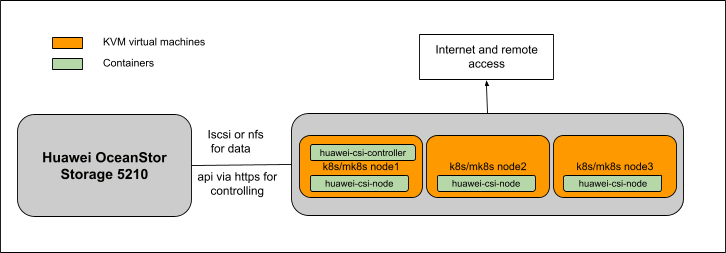
Verifying the status of Huawei CSI and Charmed Kubernetes
The tested cases and results are shown in the table below.
| Testing Item | Result | Note |
| 4.1.5 Checking the Host Multipathing Configuration | Pass | – Multipath is default installed |
| 4.1.6 Checking the Status of Host-Dependent Software | Pass | – iSCSI client is default installed – NFS client need to be installed |
| 4.2.2 Manually Installing Huawei CSI | Pass | |
| 5.1 Managing Storage Backends | Pass | – SAN (iSCSI protocol) backend (create. delete) – NAS (NFS protocol) backend (create, delete) – Configuring Multiple Backends – Creating a PVC for a Specified Backend – Creating a PVC for a Specified Storage Pool |
| 6.1.2 Manage Volume Provisioning(Storage Class) | Pass | – StorageClass (create, delete) – Nfs use fs volume type, lun for iSCSI – Configuring QoS |
| 6.1.1.1 Dynamic Volume Provisioning | Pass | – PVC (create, delete) – Volume mode Filesystem – Using pvc (pod create, delete) |
| 6.1.2 Expanding the Capacity of a PVC | Pass | |
| 6.1.3 Cloning a PVC | Pass | |
| 6.1.4 Creating a PVC Using a Snapshot | Pass | |
| 6.2 Creating a VolumeSnapshot | Pass |
Details technical blog (cluster setup, CSI integration, Pod access storage) will be published soon and referenced here.
Conclusion
Huawei Oceanstor can work with Canonical Kubernetes via the Kubernetes CSI plugin developed by Huawei via ISCSI or NFS protocol. It provides persistent data in enterprise-grade resilient storage, allows users to dynamically provision volumes, make snapshots, and attach them to the containers running in the Kubernetes cluster. This solution enables organizations to move their digital transformation further with a flexible and reliable PAAS or CAAS platform with Charmed Kubernetes.
Although the tested model is hybrid flash storage, the guidance and integration apply to all models included in the Huawei Oceanstor Dorado V700 all-flash and the Oceanstor Dorado V700 hybrid flash storage portfolio.


